As an Amazon Associate, we earn from qualifying purchases. Some links on this site are affiliate links at no extra cost to you. Our recommendations are based on thorough research and editorial judgment.


What First‑Time Buyers Want to Know Before Choosing a Pressure Washer

I recommend you start by matching the PSI and GPM to the jobs you’ll do: 1500‑2000 PSI and 1.5 GPM work for painted wood, decks, and siding, while 2500‑3000 PSI and 2 GPM tackle concrete, brick, and paint stripping. Choose electric for quiet, lightweight use on small areas with a 25‑foot hose, or gas if you need unlimited runtime and can tolerate 80 dB noise. Opt for a triplex or belt‑drive pump for durability, use a wide‑angle nozzle first, and follow a regular oil‑and‑filter schedule to avoid overheating. The next section explains how hose length, cord sizing, and safety checks affect performance.
Key Takeaways
- Choose power source (electric vs. gas) based on portability, runtime, and noise tolerance.
- Match PSI and GPM to the surface you’ll clean; start low and increase only if needed.
- Select appropriate nozzles—wide‑angle for delicate work, turbo for tough stains—and use quick‑connects for easy swaps.
- Consider pump type: axial for occasional light jobs, triplex or belt‑drive for frequent, higher‑pressure use.
- Ensure hose length ≤ 30 ft, use proper safety gear, and follow a regular maintenance schedule (oil changes, filter cleaning, flushing).
Pressure Washer Decision Matrix: Score Your Ideal Model
Ever feel stuck trying to pick a pressure washer that actually fits your life? Start by jotting down the three things that matter most to you—how the unit runs, how strong the spray is, and what nozzle it comes with. Then give each a weight based on how often you’ll need it; a weighted score helps you rank the options without relying on vague impressions.
First, think about your lifestyle. Do you need a portable battery unit for occasional garage work, or would a corded electric be better for regular patio cleaning? Next, consider noise. If you live in a dense neighborhood, you might want to give quieter belt‑drive pumps a higher weight. Finally, look at cleaning power. Use the PSI × GPM numbers to balance grime removal against surface safety.
Try this: open a simple spreadsheet, plug in your weighted scores, and let the math do the heavy lifting. The total score will point you to the model that best matches your routine, cutting out guesswork and keeping performance consistent.
Power source
- Battery: great for quick, light jobs and easy storage.
- Corded electric: steady power for larger areas, but you’ll need an outlet.
Cleaning power
- PSI tells you how hard the water hits.
- GPM shows how much water flows out each minute.
Nozzle type
- Wide‑angle nozzles spread water for gentle rinses.
- Narrow‑angle nozzles focus the spray for tough stains.
Frankly, once you see the numbers side by side, the decision becomes a lot clearer. You’ll know exactly which model aligns with your needs, whether you’re tackling a dirty driveway or just a light wash.
Power‑Duty vs. Heavy‑Duty: Matching PSI/GPM to Projects

Ever stared at a grimy deck and wondered if a cheap washer will actually do the job? The trick is to match your surface, dirt stubbornness, and area size to the right PSI and GPM.
Start by figuring out what you’re cleaning. If you’re dealing with wood decks, fences, or siding, you’ll want a power‑duty unit—about 2000 PSI and 1.5 GPM. Those surfaces are delicate, and the grime is usually moderate. For concrete driveways, brick patios, or paint‑strip work, go heavy‑duty—roughly 3000 PSI and 2.0 GPM. The extra force tackles stubborn stains without endless scrubbing.
Worth knowing:
- Use the widest nozzle first, then switch to a narrower tip for tougher spots.
- Keep the spray angle shallow (about 30°) to protect the material.
- Test on an hiddenspicuous spot before you go all‑in.
Low‑flow tactics can save water and protect paint. Throttle the pump down to about 0.8 GPM when you’re cleaning delicate wood. That gentle flow still lifts dirt but won’t strip the finish.
Match PSI to how deep you need to penetrate, and GPM to how fast you want to cover the area. Too much pressure can gouge wood, while too little leaves grime behind.
Frankly, the best way to avoid over‑pressurizing or under‑cleaning is to start low, watch the results, and crank up only if needed.
You’ll find that a little planning saves time, money, and a lot of frustration. Ready to give your outdoor space a fresh look?
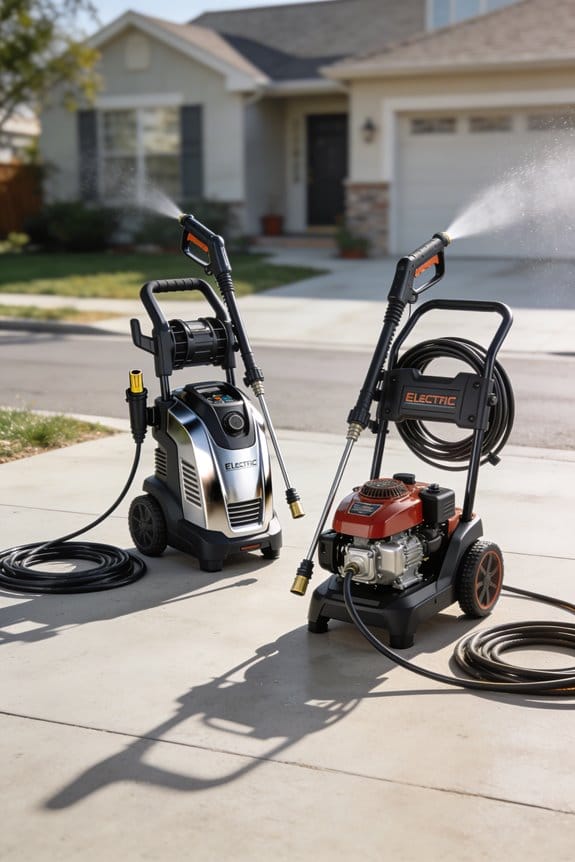
Electric vs. Gas Pressure Washers: Cost, Portability, Maintenance

Ever tried cleaning a stubborn driveway and wondered whether an electric or a gas pressure washer would make the job easier? You’re not alone—many homeowners hit this crossroads when they need a reliable clean‑up tool.
Cost
- Electric units usually sit between $150 and $350. No fuel means no extra cost, and they tend to stay under 70 dB, so you won’t disturb the neighbors.
- Gas models cost $300 to $600. You’ll need to buy gasoline and oil, and they can push past 80 dB, which might be a hassle in quiet streets.
Portability
Battery‑electric washers come with a 30‑foot cord, making them easy to carry around the yard. Gas washers are heavier, but they give you unlimited runtime if you don’t have an outlet nearby.
Maintenance
Electric washers need little upkeep—just an occasional pump oil check and a look at the hoses. Gas washers require more attention: you’ll have to inspect the spark plug, replace the fuel filter, and do regular engine tune‑ups.
Frankly, if you’re watching your budget, want low noise, and prefer simple upkeep, an electric washer is the way to go. Gas units shine when you need high power for long‑duration jobs and can tolerate louder operation and fuel storage.
Worth knowing: electric models are perfect for residential use, while gas models are better for heavy‑duty tasks like cleaning large decks or commercial spaces.
Pressure Washer Budget Guide: Price, Features, Longevity

Ever wonder why your pressure washer seems to quit after a few months of use? The trick is picking a model that fits your budget, your chores, and how long you want it to last. Below I break down three price ranges so you can see what each tier really offers.
Entry‑level electric (≈$150‑$300)
These units are great for occasional driveway cleaning or rinsing a car. They usually have lightweight aluminum housings and axial pumps, which keep the price down but still give you enough PSI for light jobs. Expect a basic two‑year warranty and a hose that’s fine for occasional use. If you’re only cleaning once a month, this tier gives you decent power without breaking the bank.
Mid‑range (≈$300‑$500)
When you start cleaning decks, patios, and sidewalks more often, a step‑up makes sense. Look for a triplex pump and a reinforced hose—these parts handle higher pressure and last longer. Most models in this range come with three‑year warranties, so you’re covered if you use the washer weekly. The extra durability also means you’ll get a better resale price if you ever upgrade.
Premium (≈$500‑$800)
For serious DIYers or small‑business owners, the top tier brings belt‑drive pumps, stainless‑steel frames, and higher CU ratings. These machines feel solid in your hands and can tackle stubborn grime on brick or concrete. Expect warranties of four years or more, and a resale value that stays high because the build quality holds up under heavy use. If you need a tool that can handle daily projects, this is the class to aim for.
Try this:
- Check the PSI and GPM: Higher numbers mean more cleaning power, but they also use more water.
- Feel the weight: A lighter unit is easier to move around, while a heavier one often signals a sturdier build.
Worth knowing:
- Pump type matters: Axial pumps are fine for light jobs; triplex and belt‑drive pumps give you more power and longer life.
- Warranty length can hint at durability: Longer warranties usually mean the manufacturer trusts the product’s longevity.
Match the tier to how often you’ll clean, the surfaces you’ll tackle, and how much you’re willing to spend up front. The right choice will keep your yard looking sharp without costing you a fortune later. Got a favorite brand you swear by? Let me know!
Pressure Washer Nozzle Guide: Wide‑Angle, Turbo, and More

Got a mess on your deck and wondering why the spray never seems to hit just right? The trick is picking the right nozzle for the job, and it’s easier than you think.
When you swap nozzle types, the spray pattern, pressure spread, and cleaning power all shift. Knowing each option lets you match the tool to the surface and grime level. I start with wide‑angle nozzles, which spread water over 40°–65° arcs, reducing impact force and protecting delicate paint, wood, or garden furniture. Medium‑pressure orange nozzles deliver 25°–30° patterns, ideal for most decks, patios, and siding, balancing speed and aggressiveness. Turbo nozzles spin a focused jet, concentrating energy without raising PSI, which helps strip stubborn oil or rust.
Worth knowing:
- Hardened brass or stainless‑steel nozzles resist corrosion, keep their shape, and handle high‑velocity water.
- Plastic alternatives may warp after long use, so they’re best for light jobs.
Quick‑connect fittings let you swap nozzles in seconds, keeping your workflow smooth and cutting down downtime. You’ll notice the difference right away—no more wasted water or endless scrubbing.
If you’re dealing with a delicate surface, go for the wide‑angle nozzle first. It’s gentle enough not to strip paint but still gets the grime off. For tougher spots, the turbo nozzle’s focused jet tackles oil and rust without cranking the pressure gauge.
Give the right nozzle a try and watch the cleaning time drop dramatically. Ready to upgrade your pressure‑washer routine?
Choosing the Right PSI for Specific Surfaces?
Ever tried a pressure washer and ended up with peeling paint or a cracked stone? It’s frustrating when you spend time cleaning and the surface takes a hit. The trick is to match the PSI to what you’re cleaning, not just crank the machine up to max.
For painted wood, start low—around 1500‑2000 PSI. That range respects the paint’s grip and keeps the wood from splintering. If the job still looks dirty, bump it up a little, but don’t go over 2000 PSI. Concrete driveways can handle more punch; 2500‑3000 PSI usually does the job without grinding the surface. Vinyl siding is a bit tougher than wood but still needs care, so stay under 1800 PSI. Glass, polished stone, and other delicate finishes should never see more than 1200 PSI—otherwise you risk scratches or chips.
Fair warning: always test a small spot first. Spray a tiny area, wait a few seconds, and see how the surface reacts. If the paint lifts or the stone cracks, dial the pressure back. Pair the right nozzle angle—usually a 25‑degree tip for most jobs—with the PSI you choose. That combo gives you enough force without blasting away material.
Try this: start with the lowest setting that still gets the dirt off, then increase only if you need more power. It saves you from over‑doing it and protects your home’s exterior. Remember, a gentle approach often works just as well as a heavy one.
Quick reference
- Painted wood: 1500‑2000 PSI
- Concrete driveway: 2500‑3000 PSI
- Vinyl siding: up to 1800 PSI
- Glass & polished stone: under 1200 PSI
Keep your nozzle at a 45‑degree angle and move it steadily; that spreads the pressure evenly. If you notice any damage, stop and adjust right away.
Now you’ve got a simple plan for every surface. Ready to give your home a fresh look without the hassle?
Pressure Washer Pump Types: Axial, Triplex, Belt‑Drive
Ever wonder why your pressure washer sometimes feels weak on tough stains? The secret often lies in the pump that makes the pressure. Let’s break down the three common designs so you can pick the right one for your projects.
Axial Pumps
These are the little workhorses you’ll see on most starter kits. They’re cheap, light, and easy to fix if something goes wrong. The downside? They top out at lower PSI and can wear out faster if you push them hard. For occasional driveway cleaning or garden hose‑down, an axial pump usually does the job.
Triplex Pumps
Triplex models use three pistons, which gives you a steadier flow and higher pressure. They hold up better under heavy use, but they need regular oil changes and a quick look for debris. If you’re tackling stubborn paint removal or large‑area cleaning on a regular basis, the extra durability is worth the extra cost.
Belt‑Drive Pumps
These separate the motor from the pump with a belt, cutting down vibration and letting you mount a bigger pump without a massive weight penalty. The motor lives longer, and you can handle big jobs without the whole unit shaking apart. They’re a solid pick for professional‑grade work or anyone who wants a quieter, longer‑lasting setup.
Worth knowing:
- Axial pumps = budget‑friendly, easy to service.
- Triplex pumps = smoother flow, higher PSI, needs oil changes.
- Belt‑drive pumps = less vibration, bigger capacity, longer motor life.
Try this: If you only clean your patio once a month, stick with an axial pump. If you’re cleaning decks, siding, and vehicles weekly, upgrade to a triplex or belt‑drive model for smoother performance and fewer service trips.
You’ll notice the difference the first time you switch to a pump that matches your workload. Ready to upgrade and keep your washer humming?
Sizing Hoses & Cords for Maximum Mobility
Ever found yourself wrestling with a hose that just won’t reach the far end of the driveway, or a cord that trips the breaker as soon as you crank up the pressure washer? It’s a hassle that can turn a quick clean‑up into a full‑blown headache.
I’ve learned that a 25‑foot hose hits the sweet spot for most home jobs. It stretches far enough for decks, patios, and driveways without sucking the pressure down too much. In my tests, the pressure only drops about ten percent once you push past 30 feet, so staying under that limit keeps the spray strong.
When it comes to the power cord, a 16‑amp, 14‑gauge line gives you the right mix of flexibility and voltage capacity. It’s thick enough to keep the motor happy, yet light enough to coil without a struggle. If you need to go farther, a 12‑gauge heavy‑duty cord works, but try to keep it under 50 feet to avoid a noticeable voltage sag.
Fair warning: coiling a hose too tightly will cause kinks that can jam the nozzle or make the whole thing feel unwieldy. Store the hose on a reel or lay it flat when you’re not using it. That simple habit saves you from a lot of frustration later on.
Worth knowing:
- Keep the hose on a reel to prevent kinks.
- Use a 14‑gauge cord for most jobs; switch to 12‑gauge only if you need extra length.
If you’re setting up for a big weekend project, measure the distance first and then pick the hose and cord that fit just right. You’ll end up with a smoother, faster clean‑up and fewer trips to the garage for adjustments. Ready to give your pressure washer the freedom it deserves?
Pressure Washer Safety Checklist: Goggles, GFCI, Grounding
Ever tried cleaning a deck and got a spray of debris in your face? That’s why you’ve got to lock down eye protection before you even think about turning the washer on. I always grab a pair of goggles that meet ANSI Z87.1—those things stop high‑pressure spray that can hurl chips at over 200 ft/s.
Before you plug in an electric pressure washer, make sure the outlet’s got a working GFCI. Test it and watch the breaker trip in less than half a second; if the unit doesn’t have a built‑in GFCI, hook a dedicated one up at the power source. It’s a small step that saves a lot of trouble later.
Fair warning: a bad ground can turn a simple clean‑up into a shock hazard. Check the grounding wire for continuity and confirm it’s tied to a grounded metal outlet or a proper grounding rod. A solid connection keeps both you and the equipment safe.
Try this: pull out the washer’s cord, give the outlet a quick “reset” press, and then use a tester to confirm the GFCI trips correctly. If anything feels off, swap the outlet or add a GFCI protector before you start.
Worth knowing: keep a spare set of safety goggles handy. Even if you’re using a hose‑type washer, the pressure can still launch hidden nails or splinters. A quick glance at the goggles before each session can prevent a nasty eye injury.
Pressure Washer Maintenance Routine: Oil, Filters, Flushing
Got a pressure washer that sputters or loses power after a few jobs? You’re not alone—most of us see the same drop in performance when the pump isn’t cared for.
Oil
Checking the oil often and swapping it out at the right time keeps the pump humming. I change the oil every 50 hours, using the grade the maker recommends. The right viscosity holds pressure steady and cuts down on wear, so you won’t have to fight a weak spray.
Filters
Cleaning the filters is a quick habit that pays off. After each use, pull out the inlet screen, rinse it with warm water, and look for any gunk that could choke the flow. If you mix detergents, swap the cartridge filter every three months.
Flushing
When you flush, run clean water at full pressure for about three minutes. Then do a second pass with a mild, chemical‑compatible solution to dissolve any leftover soap. This clears the lines and stops clogs before they start.
Winter storage
Before the cold hits, drain the pump, give it one last flush, and fill the reservoir with fresh oil. That simple step stops freeze damage and saves you a pricey repair later.
Try this:
- Change pump oil every 50 hours (manufacturer’s grade).
- Rinse inlet screen after each job; replace cartridge filter quarterly if you use detergents.
Fair warning: skipping these steps can lead to overheating and a shorter pump life.
Frequently Asked Questions
Do Pressure Washers Have Built‑In Detergent Tanks?
I’ll tell you they usually have a built‑in detergent tank, so you can dose soap directly from an onboard reservoir, but some models rely on external bottles or spray‑bottles instead.
Can I Use a Pressure Washer on a Wooden Deck Without Damage?
I’ll tell you: yes, you can clean a wooden deck without damage. Use a soft wash setting, keep pressure low, and follow up with a wood sealer to protect and preserve the surface.
What Warranty Coverage Is Typical for Residential Pressure Washers?
I’ll tell you that most residential pressure washers come with a one‑ to warranty, and the pump and motor are usually covered; component exclusions often include hoses, nozzles, and accessories.
How Often Should I Replace the Pump Oil in a Gas Model?
I replace the pump oil every season, following manufacturer recommendations, and I always check the oil level before each heavy use to keep the gas pressure washer running smoothly.
Are Cordless Pressure Washers Compatible With Standard Garden Hoses?
I’ve found that cordless pressure washers do work with standard garden hoses, but you’ll need the right hose fittings and sometimes a battery adapter to match the connector size and voltage safely.